


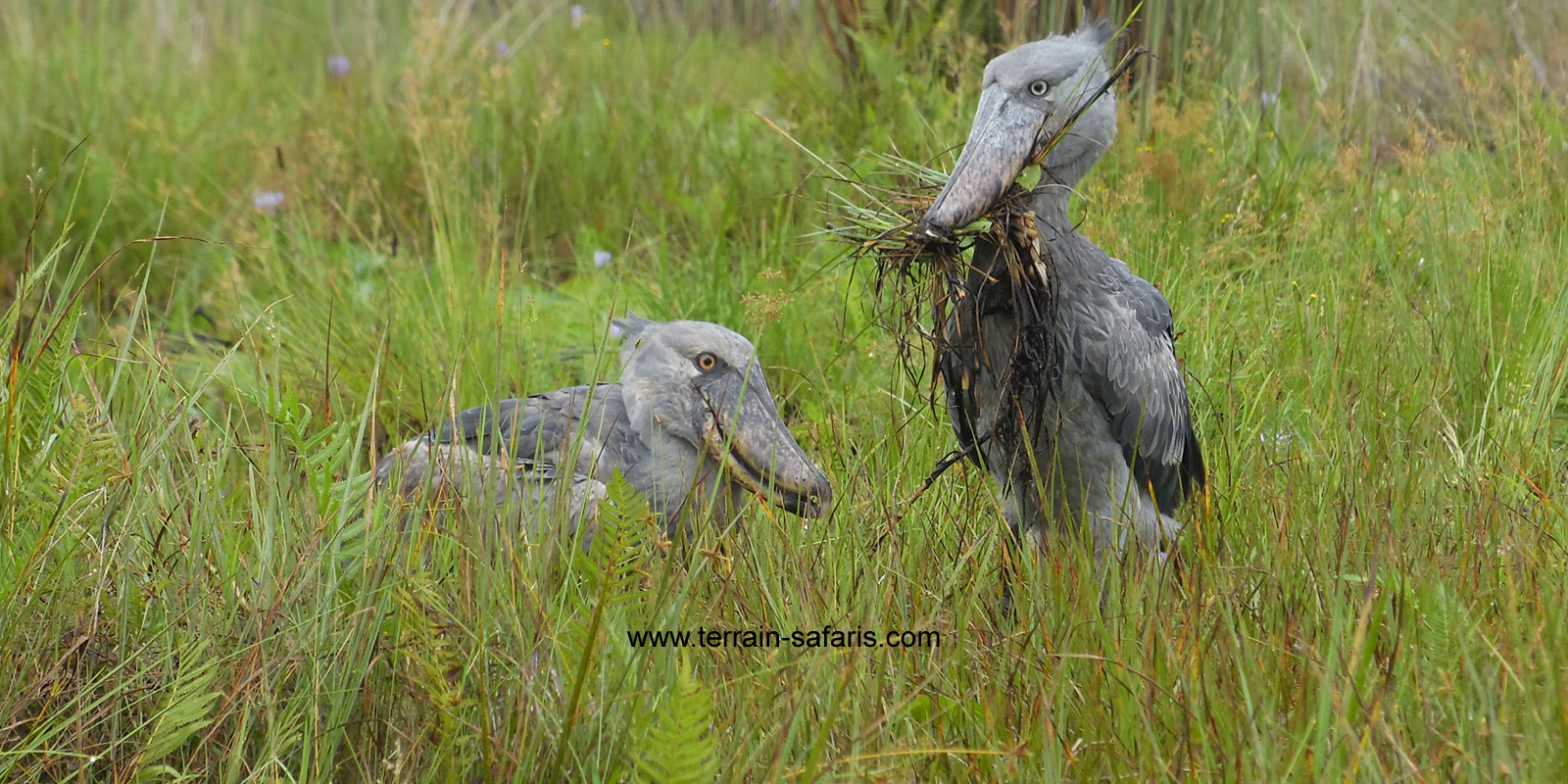
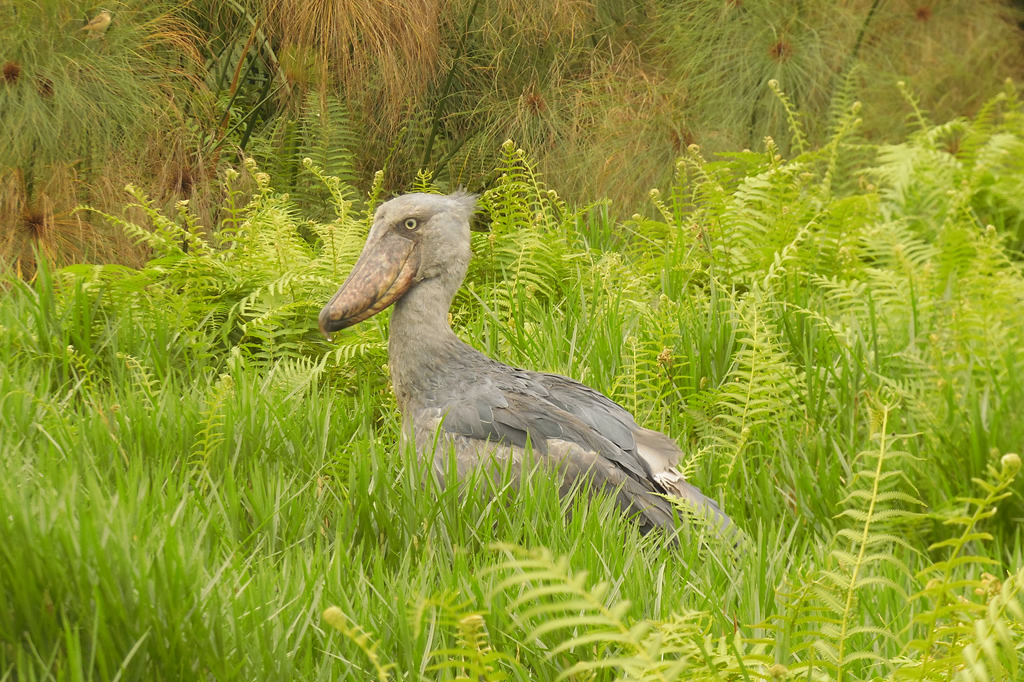
The Uganda’s Shoebill Excursions.
The Uganda's Shoebill - Africa's most fascinating bird.
 Africa’s most fascinating bird.
Family genetics
To most people the shoebill is known to be a stork, but according to the recent research it is more closely related to the pelican or heron families. They have the same little crest on the back of their head and both have a prehensile prickly tongue which they use to hold and pull food into their bill. The large bill is also similar in both birds with a hook or tooth at the tip.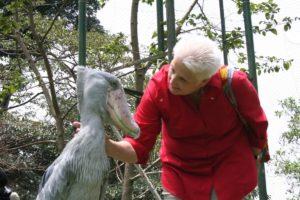
Razor sharp beak
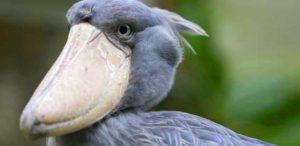
Their beaks can reach up to 24cm in length and 20cm in width, often giving the impression of an old big-nosed university professor peering over his spectacles! But don’t get too caught up in the funny comparison because their beaks mean real business and are used as a very precise fishing tool. The edges of their beaks are razor sharp, enough to decapitate a very large fish or baby crocodile.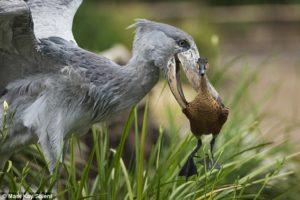
Blue-eyed beauties
They may be referred to as the “Dino birds” but they are also blessed with the blue-eyed gene. Some shoebills have exotic pale blue eyes that are quite striking to stare into. Coming face to face with one is the stuff of birding dreams!
Location
Uganda is the best East African Country where you can see the Shoebill Stork while on a Safari. Places such as Mabamba Swamp along Lake Victoria, Lugogo Swamp in Ziwa Rhino Reserve, the lower Nile in Murchison Falls Park and Lake Mburo are all places and parks where you can spot the most sought after bird in East Africa.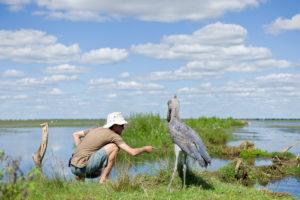
Sibling Rivalry
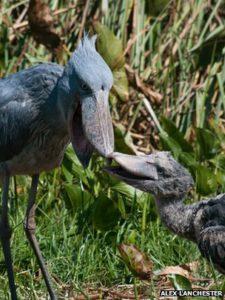
Shoebills rarely raise more than one chick. The youngest chick is known to be “insurance” in case the oldest one doesn’t make it. The sinister sibling rivalry becomes apparent when the mother leaves to fetch water and the oldest chick attacks its younger sibling often drawing blood. With limited food supply, the mother favors the eldest ensuring one of its young survives.
Some Facts About the Shoebill 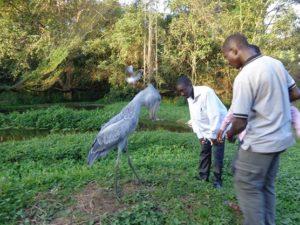
- It may be big, but it can fly if it wants to. Granted it doesn’t fly far and long flights amongst Shoebills are rare, this is no mean feat considering it can grow up to 1.5m tall and can weigh up to 7kg!
- It eats a fish that looks almost as prehistoric as itself! Although Shoebills have been known to gulp down other birds, baby crocodiles, frogs, terrapins, water snakes and even small mammals, the lungfish is their staple diet and so their whereabouts has a strong link to the regions in which these fish are found. As to whether Shoebills in fact have prehistoric links…. surely? maybe? Extensive research to their origin has scientists scrambling through the record in an apparent fruitless exercise for anything that may be a close relative of Shoebills whether fossil or living. So far only an apparent two fossil relatives have been found.
- It may look like a dutch clog stuck to its face but the Shoebill beak is a very precise fishing tool, razor sharp on its edges to sever the heads of caught lungfish, endowed with a phenomenal hook to secure anything that would want to wriggle out, and designed to shock absorb the brunt of its brutal “collapses” as it plunges with loose abandon after lungfish. The lightning fishing strike of a Shoebill is known as a “collapse” and it’s the antitheses of its patient stalking technique. Like a geological fault accumulating kinetic energy, this blue monolith will bolt downwards, when triggered loose by the rippling of an incoming fish. Head first, gape open, wings spread, smashing through vegetation, gaping through debris and hopefully coming up with a fish. Then whilst keeping his head aloft from the water, sliding its jaws sideways, it will try to sever the fish and rid itself of unwanted “condiments” in its mouthful like leaves, stems, or rootlets… a bit like sifting through a homemade breyani. After a collapse the bird is so hopelessly out of balance and transfixed on what is going on inside its bill, that regaining its vertical stance requires the use of the wings, wiry and lanky legs, and every ounce of spastic counterbalancing its minute tail can possibly generate. Controlled motion are not terms that come to mind to describe this process, and possibly this is the reason why they fish solitarily. A comical sight to watch, it’s very hard to hold back a comment or hark of laughter.
- The Shoebill is so much cooler than anyone can think! its large bill comes in very handy to carry large “gulps” of fresh water back to the nest in order to douse eggs or chicks when the sweltering heat of the swamps drives temperatures beyond normality. Other fascinating techniques to cool down involve defecating on his legs as others storks do too, or gulag-fluttering which is the same as dog panting, in birdie speak.
- It can do that cool disappearing act with its eyes. The nictating membrane of a shoebill is a translucent layer that protects its eyes nits as it awaits its prey.
- The shoebill has a little bit of an identity crisis. While it may be called a stork, morphologically/taxonomically speaking it shares more traits with herons and pelicans, in fact recent genetic studies suggest it should be better described as an odd, one of a kind, unique family within the Pelicans and can even be referred to as a missing link amongst species.
- Along with its wife, the male also cares for the young ones. However even though two babies are born only one is raised and the other serves as a “back-up” should something happen to the first. Beyond that, adults perform a whiney-mewing muttering when attending a nest, that often elicits a “hiccupping” gurgle from their chicks as they beg in anticipation for food. Indeed, a creature of few words, Shoebills have a surprisingly small repertoire of vocalizations despite their huge mouth, however bill clapping like storks have been heard in the dark and wee hours. One might fear to get close to it but humans don’t have to worry. Shoebills, which live in the swamps of eastern tropical Africa, are after smaller prey. But only slightly smaller. They eat big fish like lungfish, eels, and catfish, and also crazy stuff like Nile monitor lizards, snakes, and baby crocodiles.
And they hunt like total bosses of the swamp. The Shoebill will stand there, motionless as a statue, and wait for some poor lungfish or baby crocodile to swim by. Then the bird will pounce forward, all five feet of it, with its massive bill wide open, engulfing its target along with water, mud, vegetation, and probably any other hapless fish minding their own business. Clamping down on its prey, the bird will start to swing its massive head back and forth, tipping out whatever stuff it doesn’t want to eat. When there’s nothing but lungfish or crocodile left, the Shoebill will give it a quick decapitation with the sharp edges of the bill (because of course it does) and swallow away.
Its sound is terrifying and it’s also impossible not to be impressed by these giants. Shoebills have been a beloved species for a long time. They appear in the artwork of the ancient Egyptians. Arabs reportedly called the bird Abu-Markhub, or “father of the shoe/slipper” (just can’t get away from that shoe imagery).
So, anything cool about the bill other than that it’s gigantic, looks like footwear, and how it can decapitate crocodiles. It makes awesome machine-gun noises, Shoebills are silent most of the time but engage in “bill-clattering” around the nest or when greeting another bird. It’s loud and scary and the last sound that lots of poor monitor lizards ever hear. They crap on their own legs because it keeps them cool. As with other birds, the poop is mostly liquid, and heat from warm blood passing through the legs is used to evaporate the liquid waste, resulting in cooler blood circulating through the stork. The science is fascinating, but when you get right down to it, this already mean-looking bird with a huge, clattering death bill now also has poop legs.
Beastly and terrifying though they are, it would be a real shame to have a world without Shoebills. Young crocodiles would be everywhere! Eels! Monitor lizards! Our children and grandchildren would be overwhelmed. Lungfish, everywhere! Let’s work on appreciating these feathered monsters, and let them do their mud-eating, decapitating thing. But you might not want to look at them too closely. That death stare will haunt you in your dreams. So, with Terrain Safaris Uganda,(www.terrain-safaris.com) we promise to take you in every corner of Uganda to enable you have an everlasting experience in the Elusive-Ancient Shoebill Stork of Uganda.