
- admin
- November 24, 2026
- Our Blog
Our Blog
Bird Watching in Uganda
Uganda is a country of modest size but exceptional natural wealth. Straddling the equator and spanning a remarkable range of habitats, from snow-capped mountains and ancient rainforest to papyrus swamp and open savannah, it has recorded well over a thousand bird species, roughly half of all those found in Africa. For visiting birders, this concentration of diversity within a compact and well-connected country is a considerable attraction. This guide offers an overview of what makes Uganda such a rewarding birding destination, the species and places most often sought, and the practical points worth considering when planning a trip.
Why Uganda Is Exceptional for Birds
Published totals for Uganda’s bird list vary somewhat, with commonly cited figures ranging from about 1,060 to more than 1,090 species, depending on the source and the date of the count. Whatever the precise figure, the point is clear: Uganda holds an extraordinary proportion of the continent’s birdlife within an area smaller than the United Kingdom.
Several factors explain this richness. The country lies at a meeting point of major African ecological zones, drawing together species of the East African savannah, the Congo Basin rainforest, and the highland forests of the Albertine Rift. It is also home to large lakes and wetlands, extensive protected areas, and a wide range of altitudes, each of which supports its own community of birds. For the visitor, this means that a single itinerary can include forest specialists, waterbirds, raptors, and open-country species without the need for long international transfers.
The Albertine Rift Endemics
Among the great attractions for serious birders are the Albertine Rift endemics, species found only in the montane forests of the western arm of the East African Rift, which extends through Uganda, Rwanda, Burundi, the Democratic Republic of Congo, and north-western Tanzania. Uganda offers access to around two dozen of these birds, and Bwindi Impenetrable National Park is the principal stronghold, with roughly 23 recorded there, some of which are found nowhere else in Uganda.
The African green broadbill is perhaps the most celebrated, a small, vividly coloured forest bird that is a top target for many visitors. The Ruhija sector of Bwindi, and in particular the trail to Mubwindi Swamp, is widely regarded as the most reliable place to look for it. Other highlights of the region include the Rwenzori batis, Shelley’s crimsonwing, and a range of sunbirds, warblers, and greenbuls that reward patient observation. The Rwenzori Mountains and Mgahinga Gorilla National Park offer further opportunities to see these highland specialities.
The Shoebill and Uganda’s Wetlands
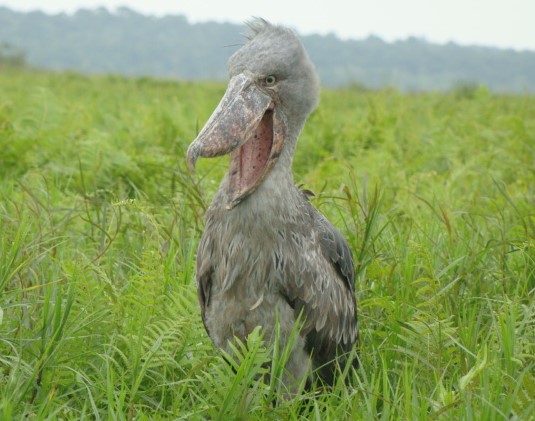
No bird is more closely associated with Ugandan birding than the shoebill. This large, prehistoric-looking wetland bird is difficult to find in most of its range, but Uganda offers several accessible sites. Mabamba Bay Wetland, roughly forty kilometres west of Entebbe, is widely regarded as the most convenient and reliable, and a visit by canoe can be arranged within a half day, which makes it ideal for the beginning or end of a trip. The Nile delta area of Murchison Falls National Park provides another strong option, as does the swamp at Semuliki.
Beyond the shoebill, Uganda’s wetlands support a rich community of waterbirds and papyrus specialists, including the papyrus gonolek and various herons, kingfishers, and rails. Queen Elizabeth National Park, with its lakes, channels, and savannah, has recorded more than 600 species, making it among the richest protected areas in the country for general birding.
Forests and Their Specialities
Uganda’s forests offer some of the most distinctive birding in Africa. Bwindi, with about 350 species recorded, is the heart of the Albertine Rift experience. Kibale Forest National Park, with roughly 375 species, is celebrated for its forest-interior birds and for primates, particularly chimpanzees. Budongo Forest, with approximately 360 species, offers Central African forest birds that are difficult to see elsewhere in Uganda, and the Royal Mile and the Kaniyo-Pabidi area are the best-known birding locations within it.
Semuliki National Park, in the far west of the country, lies at the eastern edge of the Congo Basin and is reported to have recorded around 440 species, including many that occur nowhere else in Uganda. Its lowland forest and hot springs and its proximity to the Rwenzori range, make it an appealing addition to a western Uganda circuit. For those travelling from Kampala, smaller sites such as Mpanga Forest offer a convenient introduction to Ugandan forest birds without the need for a long journey.
Savannah and Dry-Country Birding
Not all of Uganda’s best birding lies in forests and wetlands. Murchison Falls National Park, Queen Elizabeth National Park, and Lake Mburo National Park offer open-country species that include the secretary bird, various bee-eaters, hornbills, and an impressive range of raptors. Lake Mburo is also a convenient stop between Kampala and the south-west, and it offers species that are less easily found elsewhere on the standard route.
For those who wish to explore beyond the most popular circuits, the dry savannah of Karamoja in the north-east offers a different set of birds altogether. Reserves such as Pian Upe provide opportunities to see dry-country specialities in a quiet and little-visited setting, and Kidepo Valley National Park offers further distinctive species. These destinations suit birders seeking a more adventurous itinerary and a sense of wilderness.
When to Go
Birding in Uganda is rewarding throughout the year, but seasonal patterns can help in planning. The drier months, generally December to February and June to August, tend to offer firmer trails and more comfortable conditions, which is especially valuable in the steep forests of Bwindi and elsewhere. Palearctic migrants, which breed in Europe and Asia and spend the northern winter in Africa, are present in Uganda broadly between October or November and April, and they add considerable variety to the resident list.
The wetter months, roughly March to May and September to November, can make some trails and roads more difficult, but they also bring breeding activity and a greener landscape, and the country is generally quieter at that time. Given that rainfall patterns vary from year to year, we would suggest confirming current conditions with a local operator closer to the time of travel.
Planning a Birding Trip
Most visiting birders find that a trip of ten days to two weeks allows a good cross-section of Uganda’s habitats to be covered. A classic itinerary might begin with Mabamba Swamp near Entebbe, continue to Mpanga Forest or Lake Mburo, move on to Bwindi and Ruhija for the Albertine Rift endemics, and include Queen Elizabeth National Park and Kibale Forest, before finishing in the north with Budongo Forest and Murchison Falls. Many visitors also combine their birding with gorilla trekking in Bwindi or chimpanzee tracking in Kibale, which allows both interests to be pursued within a single journey.
Engaging an experienced local birding guide is strongly recommended. Uganda’s guides possess detailed knowledge of bird calls and favoured locations, and they greatly increase the number of species that visitors are able to see, particularly among the shy and well-concealed forest birds. A guide also helps with logistics, trail conditions, and permits, and their employment supports local communities.
What to Bring
Good binoculars are the most important item of equipment, and a field guide to the birds of East Africa is a valuable companion. A camera with a telephoto lens will be useful for those interested in photography, although forest conditions are often dark and demanding. Sturdy, waterproof walking boots are advisable, particularly for muddy forest trails, along with light waterproof clothing, insect repellent, sun protection, and layers for cool early mornings. An early start is nearly always rewarded, since birds are most active in the first hours after dawn.
Birding Responsibly
Visitors can help to protect Uganda’s birds by following responsible practices. These include keeping a respectful distance from nesting birds, avoiding the use of playback calls in sensitive areas or around rare species, staying on marked trails, and following the guidance of local guides and park rangers. Choosing operators and lodges that contribute to conservation and local communities ensures that tourism continues to support the protection of the habitats on which the birds depend.
Conclusion
Uganda offers birders an unusually rich and varied experience, combining globally sought-after species such as the shoebill and the African green broadbill with an impressive diversity of forest, wetland, and savannah birds. Its well-developed network of parks and guides, and its ability to be combined with other world-class wildlife experiences, make it a practical as well as a rewarding destination. With careful planning, an experienced guide, and a measure of patience, a birding trip to Uganda is an experience that few visitors will soon forget.