
- admin
- October 16, 2026
- Safaris
Our Blog
Birding Pian Upe Wildlife Reserve, Uganda
Uganda’s second-largest protected area: an expansive stretch of Karamoja savannah supporting cheetah, roan antelope, and a growing population of other plains game.
Most visitors who travel to Uganda for birds head west, towards the forests of Bwindi and the Albertine Rift. Far fewer venture north-east, to the dry savannah of Karamoja, where a different and equally rewarding avifauna awaits. Pian Upe Wildlife Reserve, a vast and little-visited protected area, offers birders the chance to see dry-country species that are difficult or impossible to find elsewhere in the country, set within a landscape of open grassland, acacia woodland, and rocky hills. This guide outlines what makes Pian Upe distinctive, the birds one may hope to encounter, and the practical considerations involved in planning a visit.
An Expansive and Lesser-Known Reserve
Pian Upe lies in the Karamoja sub-region of north-eastern Uganda, in the area of Nakapiripirit and Moroto districts, and is managed by the Uganda Wildlife Authority. Its history as a protected area dates back to 1958, when its southern part was designated as the Debasien Animal Sanctuary, and in 1964 the area was expanded northward and renamed Pian-Upe Game Reserve. Conservationists describe it as Uganda’s second-largest protected area, covering more than 2,000 square kilometres, and much of it is made up of undisturbed grassland and wooded grassland.
The reserve has a semi-arid climate, and its character is strikingly different from the green, humid forests that dominate the itineraries of most visitors. Dominant vegetation includes thatching grass and Setaria species, interspersed with acacia woodland. This is open country, and for birders that openness is an advantage: raptors and large ground birds can be observed across long distances, in conditions that dense forest simply cannot offer.
In 2022, a co-management agreement brought together Space for Giants, the Uganda Wildlife Authority, Karimojong Overland Safaris, and nine district governments, with the shared aim of restoring and protecting the reserve. The effort is reported to be bringing wildlife back, and to be engaging local communities in the process, which gives Pian Upe the quality of a destination still very much in the making.
The Birdlife
Published figures for the reserve’s bird list vary. Several tour operators cite a total of around 242 species, while conservation sources that include the neighbouring Lake Opeta wetland system quote a figure of more than 525. This difference most likely reflects the area being counted, and visitors should treat any single number with appropriate caution. What is clear is that Pian Upe supplements the typical Ugandan national park bird list with a notable group of dry-country specialists.
The reserve’s most sought-after bird is the Karamoja apalis, a small, range-restricted species that favours stands of whistling-thorn acacia scrub. It is classified as Vulnerable by the IUCN and is threatened by habitat loss, which makes a sighting at Pian Upe especially valuable for birders interested in conservation as well as list-building. Locating it generally requires patience, a local guide, and an early start.
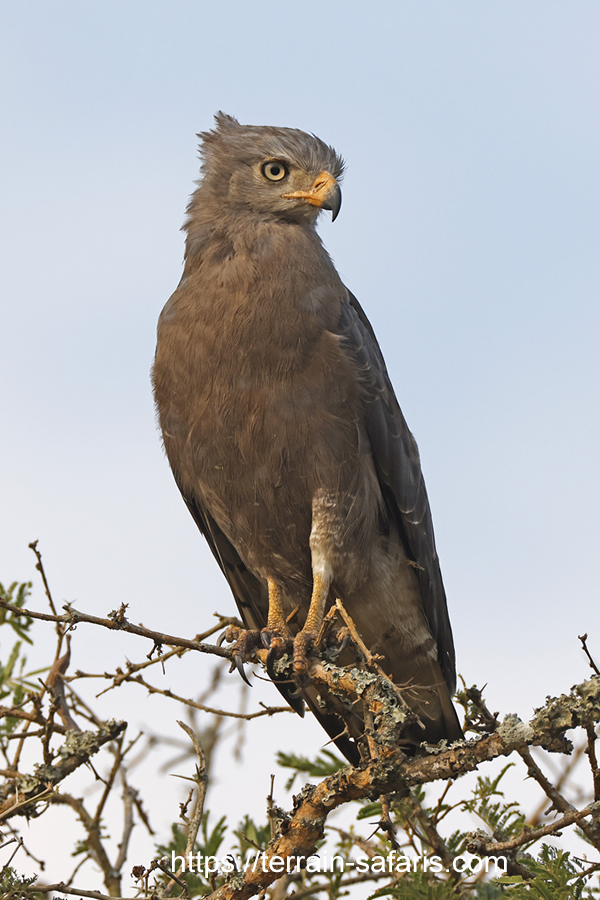
Beyond this headline species, the open savannah offers a procession of larger and more conspicuous birds. Visitors report ostriches, secretary birds, Abyssinian ground hornbills, Jackson’s hornbills, Hartlaub’s bustards, superb starlings, and white-headed buffalo weavers, among others. Raptors are particularly diverse and are often seen during game drives, soaring over the plains or perched on isolated trees where they can be observed at leisure. The combination of terrestrial specialists and raptors gives a day’s birding at Pian Upe a rhythm quite unlike that of a forest outing, with fewer but more visible birds and a greater sense of space.
Lake Opeta and the Wetland Birds
The reserve overlaps with, and lies immediately north of, Lake Opeta, a Ramsar-listed wetland system designated in 2006. The wetland serves as a dry-season refuge for wildlife from the reserve, and it supports thousands of waterbirds. Notable species recorded there include the globally threatened shoebill and the near-threatened papyrus gonolek, along with Fox’s weaver, which is often described as Uganda’s only endemic bird species.
For birders, this pairing of dry savannah and wetland adds a valuable dimension to a visit. A single itinerary can therefore combine the Karamoja specialities of the plains with the water birds and papyrus specialists of the lake margins. Access to the wetland and the best viewing areas can vary with the season and with local conditions, and we would recommend arranging this portion of the trip in advance with an operator familiar with the area.
Mammals: A Valuable Supporting Cast
Although this article focuses on birds, no account of Pian Upe would be complete without its mammals, which add considerable interest to a birding visit. The reserve shelters cheetah, Nubian giraffe, and roan antelope, the last of which is reported to be found in Uganda only here. Other species commonly mentioned include zebra, eland, greater kudu, Jackson’s hartebeest, Uganda kob, oribi, mountain reedbuck, buffalo, waterbuck, and a number of predators such as lion, leopard, and spotted hyena.
Two antelope species are particularly characteristic of Karamoja. The tiang, a migratory antelope closely related to the topi, occurs in Uganda only in this region, and Pian Upe holds one of the country’s more significant populations, with herds moving through the reserve during the wet season. Bright’s gazelle is another Karamoja specialist, found on open short-grass areas. Wildlife numbers are described as growing as protection improves, and visitors should accept that sightings of individual species can vary from day to day and from season to season.
When to Visit
Pian Upe can be visited throughout the year, but conditions differ with the seasons. The reserve has a semi-arid climate, with rainfall in the wider Karamoja region typically peaking around April and May and again in November. The wet season brings an abundance of food, which tends to increase bird activity and makes the grasslands greener and more attractive, though some tracks may become difficult to pass. Operators note that the wet months, roughly March to May and November, are productive for birding.
The drier months, by contrast, offer easier driving conditions and concentrate wildlife around remaining water sources, including the Lake Opeta wetlands. Migratory birds from Europe and Asia are present in Uganda broadly between October and April, and they add to the variety of species seen during that period. As with any remote destination, we would encourage prospective visitors to confirm current road conditions and rainfall patterns with a reputable local operator close to the time of travel.
Practical Considerations
Pian Upe is a remote destination, and planning is more important here than at many of Uganda’s better-known parks. The nearest major centre is Mbale, and the reserve is typically reached by road from there, often as part of a wider north-eastern itinerary. A sturdy four-wheel-drive vehicle is advisable, and most visitors travel with an experienced driver-guide or a tour operator who knows the area. Many itineraries pair Pian Upe with Kidepo Valley National Park, Sipi Falls, and Mount Elgon, creating a circuit that covers the full range of Karamoja wildlife and landscapes.
Accommodation within and near the reserve is limited but available. Options reported include Karamoja Overland Camp, as well as Uganda Wildlife Authority bandas and camping. Because facilities are modest and the reserve is remote, advance booking is strongly recommended, along with confirmation of current fees, access arrangements, and guiding options directly with the Uganda Wildlife Authority or a licensed operator.
Visitors should bring binoculars of good quality, since open-country birding frequently involves distant viewing, and a spotting scope can be a worthwhile addition. Sun protection, plenty of drinking water, a wide-brimmed hat, and light, neutral-coloured clothing are essential in the dry heat, while a rain jacket is advisable during the wetter months. A field guide to the birds of East Africa will help with the many similar-looking raptors, larks, and weavers likely to be encountered.
Conclusion
Pian Upe Wildlife Reserve offers a quieter, more adventurous alternative to Uganda’s established birding circuits. Its combination of Karamoja specialities such as the Karamoja apalis, a diverse raptor population, the wetland birds of nearby Lake Opeta, and a recovering population of plains game makes it a compelling destination for those willing to travel beyond the usual routes. For birders seeking a different side of Uganda, and a genuine sense of wilderness, Pian Upe is well worth the journey.