
- admin
- October 15, 2026
- Safaris
Our Blog
Bird Watching in Mpanga Forest, Uganda
Uganda is renowned for its remote and dramatic birding destinations, from the montane forests of Bwindi to the savannahs of Murchison Falls. Yet one of the country’s most convenient and rewarding forest birding sites lies just a short drive from the capital. Mpanga Forest, near the town of Mpigi, offers visitors an opportunity to encounter a wide range of forest birds without the lengthy transfers that many other sites require. This guide outlines what makes Mpanga Forest a worthwhile destination, the species one may hope to see and the practical considerations involved in planning a visit.
A Compact Forest Close to Kampala
Mpanga Central Forest Reserve is a small patch of natural equatorial rainforest in Mpigi District, roughly 37 kilometres south-west of Kampala along the Masaka highway. According to the National Forestry Authority, the reserve covers approximately 453 hectares, which makes it one of Uganda’s smaller natural forests. Some tourism sources quote a larger figure, so visitors may encounter differing numbers, but the smaller area is the one supported by the managing authority.
The forest has a long history of protection. It was set aside as a scientific research site in 1953, and its dominant tree species is the hard, weather-resistant Celtis. Over 500 species of trees and shrubs are reported, together with close to a hundred butterfly species and more than a hundred moth species. For a forest of its size, the biodiversity is remarkable, and it is this concentration of life within a compact, easily walked area that appeals so strongly to birders and naturalists alike.
The Birdlife of Mpanga
Published figures for the number of bird species at Mpanga vary considerably. The National Forestry Authority and several tour operators cite a figure of around 300 species, whereas other sources give lower totals of roughly 180 to 200. Visitors should therefore treat any single number with some caution. What is beyond dispute is that the forest is productive for common and widespread Ugandan forest birds, and that it ranks among the best places near Kampala to see them.
Among the species most often mentioned are the black-and-white casqued hornbill and the African pied hornbill, both of which announce their presence with loud wingbeats and calls in the canopy. The great blue turaco and Ross’s turaco bring colour to the treetops, and the African grey parrot, though often heard before it is seen, is a notable resident. The blue-breasted kingfisher is a further highlight, along with a range of cuckoos and owls for those who bird at the edges of the day.
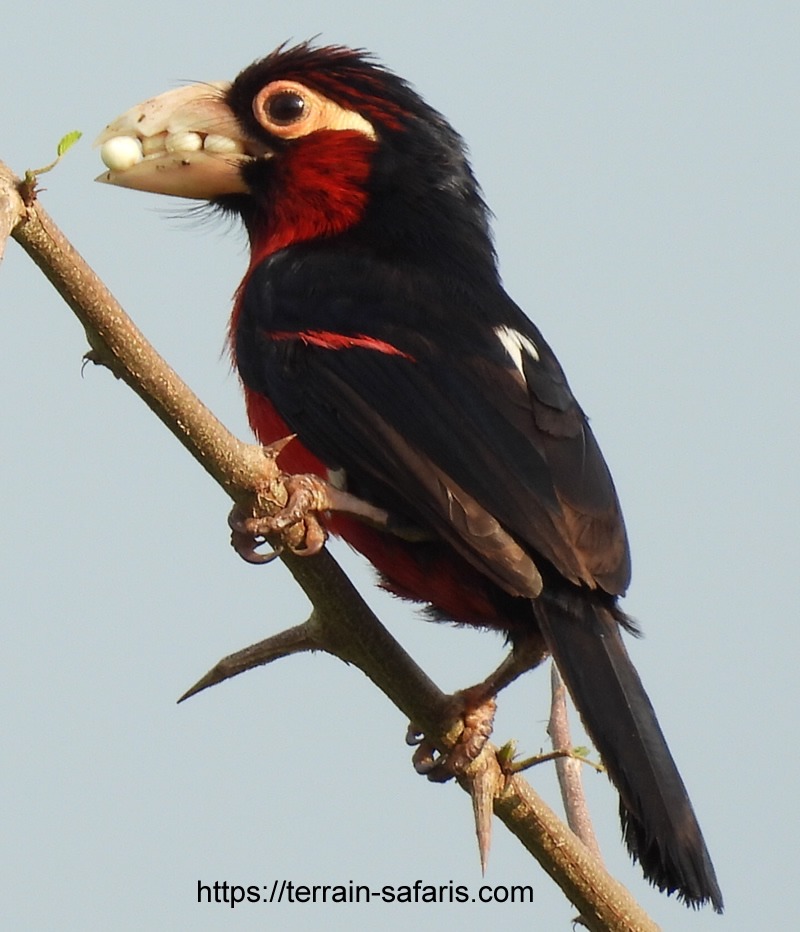
The understorey and mid-storey reward patient observation. Visitors report species such as the spotted greenbul, the Uganda woodland warbler, Fraser’s ant-thrush, the green crombec, the grey-green bush-shrike, the pink-footed puffback, and Weyns’s weaver. Many of these are shy, quick-moving, or easily concealed by foliage, and the experience of locating them is part of what makes forest birding so absorbing. Birders compiling a Uganda list will find Mpanga a convenient place to secure a good number of the country’s forest species early in a trip, before travelling on to more remote destinations.
Trails and Birding Routes
Birding at Mpanga typically begins at the visitor information area at the forest edge, where a cleared space provides a convenient starting point and a chance to scan the canopy in good light. Three principal trails are commonly described, and each offers a somewhat different experience.
The baseline trail, of about three kilometres, leads west through the forest and crosses two streams before emerging at Nakyetema swamp. This papyrus wetland is home to sitatunga and is also reported as a site for the shoebill, although both are described as present but rarely seen. The trail is useful for observing the transition between forest and swamp birds.
The Hornbill loop, of about five kilometres, covers more undulating terrain and crosses several streams along minor footpaths. It passes a striking tree-root arch and takes visitors deeper into the forest interior, where hornbills and other canopy species are more likely to be found.
The butterfly trail, at roughly one kilometre, is the shortest option and can be completed in about an hour. It provides clear views of the forest canopy and surrounding villages and is well suited to those with limited time, to families, or to visitors who wish to combine birds with butterflies and monkeys.
Because the main trails are clearly marked, some visitors choose to bird independently without being concerned about becoming lost. Nonetheless, we would recommend engaging a local guide where possible. A guide’s knowledge of calls and favoured perches considerably improves the number of species seen, particularly among the secretive understorey birds, and a visit also supports the local community.
Other Wildlife
Although birds are the principal attraction, Mpanga offers a pleasing supporting cast. Three monkey species are commonly cited: the red-tailed monkey, the vervet monkey, and the black-and-white colobus. The forest also supports bushbuck, bush pigs, and flying squirrels, and visitors who remain after dark may have a chance of encountering nocturnal species such as pottos and bushbabies. Night walks, where available, can be a memorable addition for those staying nearby.
Butterflies are a further feature, with a notable variety recorded in the forest. Together with the moths, they make Mpanga a rewarding destination for visitors with a general interest in natural history, and a good place to introduce less experienced companions to the pleasures of forest walking.
When to Visit
Mpanga can be birded throughout the year, as is the case with most Ugandan forests. The drier months, generally December to February and June to August, tend to offer firmer trails and more comfortable walking conditions. The wetter periods, typically March to May and September to November, can make paths slippery and some streams harder to cross, though the forest is often particularly lush and vocal at that time.
Early morning is the most productive time of day, when birds are most active and vocal, and the cooler temperatures make for more pleasant walking. A birding outing of around three hours is often sufficient to see a good range of species, though more dedicated birders may wish to spend a full day working the different trails. Migratory species from Europe and Asia are present in Uganda between roughly October and April, and these may add modest variety to the resident species during that period.
Practical Considerations
Mpanga Forest lies approximately 37 kilometres from Kampala, which makes it suitable for a day trip or a half-day excursion. Because it sits along the Masaka highway, it also serves as a convenient stopover for travellers heading to destinations in western and south-western Uganda, including Lake Mburo National Park and Bwindi Impenetrable National Park. This positioning allows visitors to begin their birding on the first or last day of a longer itinerary, using time that might otherwise be spent solely on the road.
A particularly attractive combination is to pair a morning at Mpanga with a visit to Mabamba Swamp, which lies in the same general direction and is roughly thirty minutes away by road. Mabamba is celebrated as a reliable site for the shoebill and for water birds, so the two sites together offer a rewarding contrast between forest and wetland birding in a single day. Visitors seeking a forest alternative on the eastern side of Kampala may also consider Mabira Forest Reserve.
Entry arrangements, guide fees, and available facilities are managed through the National Forestry Authority and, in some cases, onsite lodging operators, and these are subject to change. We would therefore suggest confirming current details in advance, either directly or through a licensed tour operator. Visitors should bring comfortable walking shoes suitable for damp ground, light waterproof clothing, insect repellent, drinking water, and binoculars. A field guide to the birds of East Africa will also prove valuable, given the number of similar-looking forest species.
Conclusion
Mpanga Forest may be modest in size, but it offers a genuinely rewarding birding experience within easy reach of Uganda’s capital. Its well-marked trails, diverse forest birdlife, and supporting cast of primates and butterflies make it an excellent introduction to Ugandan forest birding, and a worthwhile addition to almost any itinerary that begins or ends in Kampala. For visitors with limited time, or for those seeking a gentle start before heading to more distant parks, Mpanga is a destination well worth including.