- admin
- September 25, 2026
- Our Blog
Our Blog
Shoebill and Birding Excursions at Mabamba Wetland Sanctuary, Uganda
Tucked along the northern shores of Lake Victoria, not far from Uganda’s capital, Mabamba Wetland Sanctuary has earned a well-deserved reputation as one of the finest and most accessible birding destinations in East Africa. Renowned above all as one of the most reliable places on the entire continent to observe the extraordinary Shoebill Stork, Mabamba offers visitors a rewarding and remarkably convenient introduction to Ugandan birding, requiring only a short journey from Kampala or Entebbe rather than the more extensive travel demanded by some of the country’s other renowned birding sites. This article offers a considered overview of what visitors may expect from a Mabamba birding excursion, the sanctuary’s ecological significance, and practical guidance for planning a visit.
An Introduction to Mabamba Wetland Sanctuary
Mabamba Bay Wetland Sanctuary comprises an extensive area of papyrus swamp, open water channels, and seasonally flooded grassland, forming part of a designated Ramsar site recognised for its international importance as a wetland ecosystem. Located on the western shore of Lake Victoria, within Mpigi District, the sanctuary lies roughly a one-hour drive and short boat crossing from Entebbe, making it readily achievable as a half-day excursion for visitors based in either Kampala or Entebbe.
The wetland’s importance extends well beyond its avian residents. As with many such ecosystems, Mabamba serves a valuable ecological function in water filtration, flood regulation, and fish breeding, while also supporting the livelihoods of local fishing communities. The sanctuary is managed with meaningful involvement from these communities, whose traditional knowledge of the wetland’s channels and wildlife has proven invaluable in guiding visitors safely and effectively through this sometimes labyrinthine landscape.
The Shoebill Stork: Mabamba’s Star Attraction
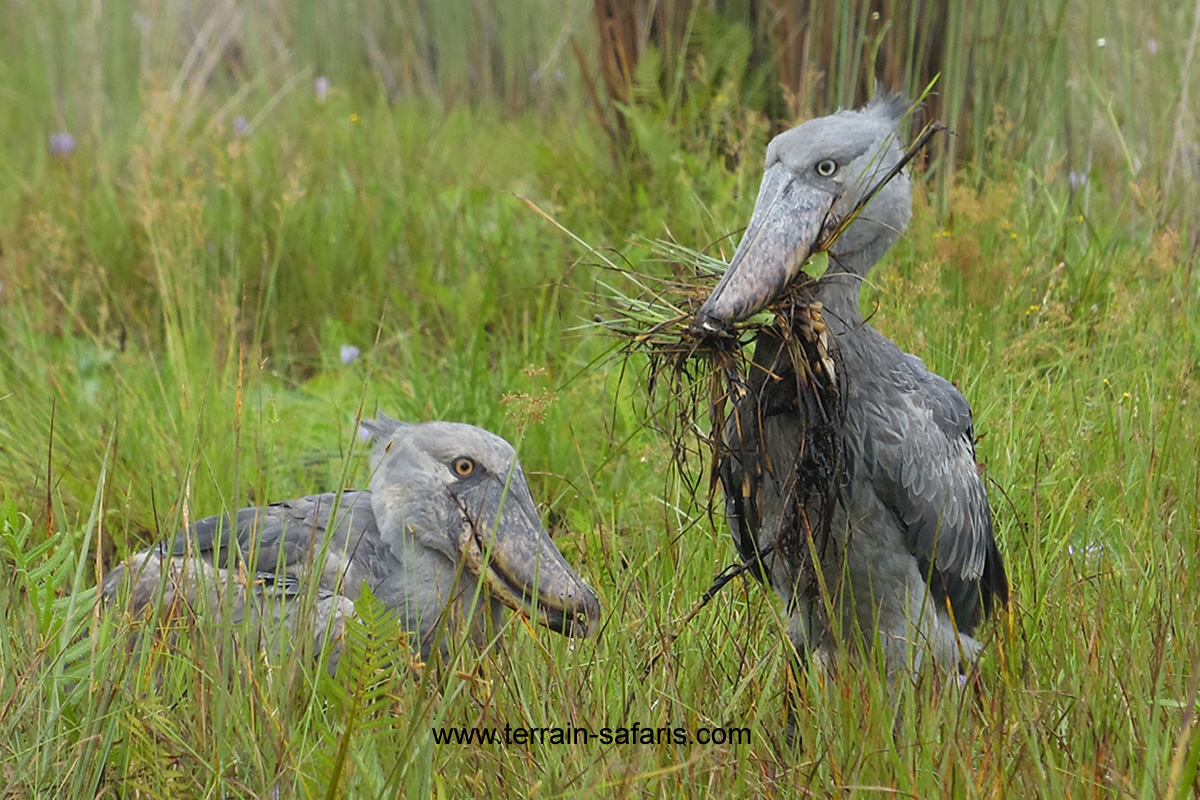
The principal draw for the great majority of visitors to Mabamba is, without question, the opportunity to observe the Shoebill Stork, a genuinely remarkable bird whose appearance has often been likened to that of a prehistoric creature. Standing over a metre tall, with an enormous, bulbous bill and a stationary, almost statuesque hunting posture, the Shoebill possesses a distinctive character that has made it something of a legendary sighting among birders worldwide.
Mabamba’s extensive papyrus and lungfish-rich waters provide ideal habitat conditions for the Shoebill, which feeds primarily on lungfish, catfish, and occasionally small reptiles, employing a patient, almost motionless hunting technique before striking with remarkable speed and force. The sanctuary’s resident population, while naturally limited given the species’ solitary and territorial habits, has made Mabamba one of the more consistently reliable sites globally for Shoebill sightings, with many guided excursions reporting success rates considerably higher than at comparable sites elsewhere in Africa.
It is worth noting, however, that while sightings are frequent, they are never entirely guaranteed, given that the Shoebill remains a wild, free-ranging bird rather than a captive or habituated animal maintained for viewing purposes. Visitors are encouraged to approach their excursion with appropriate patience and realistic expectations, while taking comfort in Mabamba’s genuinely favourable track record.
The Wider Birding Experience
While the Shoebill rightly commands considerable attention, Mabamba’s broader birdlife offers a rich and rewarding experience in its own right, with over 300 recorded species inhabiting the sanctuary’s varied wetland and grassland habitats. Visitors can reasonably expect to encounter African Jacana delicately navigating lily pads, the striking Malachite Kingfisher perched along the water’s edge, and the distinctive, somewhat comical Blue-headed Coucal moving through the papyrus.
Papyrus Gonolek, a strikingly coloured species largely restricted to papyrus wetland habitats, is a further highlight for many visitors, alongside African Purple Swamphen, Long-toed Lapwing, and numerous species of heron and egret. During the Palearctic migration season, running roughly from November through April, the sanctuary’s diversity is further enriched by the arrival of migratory waders and warblers, adding considerable additional interest for visitors travelling during these months.
This combination of a genuinely world-class target species alongside a broader wealth of accessible wetland birdlife makes Mabamba an unusually efficient destination, offering considerable birding reward within a relatively brief and logistically straightforward excursion.
The Canoe Excursion Experience
A defining feature of the Mabamba birding experience is the mode of exploration itself. Rather than viewing wildlife from vehicles, as is customary in many of Uganda’s savannah parks, visitors explore Mabamba’s channels aboard traditional wooden canoes, paddled by experienced local guides who possess an intimate knowledge of the wetland’s layout and the habitual movements of its more elusive residents, the Shoebill included.
This quiet, low-impact method of exploration offers a genuinely immersive experience, allowing visitors to drift gently through narrow papyrus channels with minimal disturbance to wildlife, and affording excellent opportunities for photography given the proximity often achieved with cooperative subjects. Excursions typically last between two and three hours, departing in either the early morning or late afternoon, periods generally associated with heightened bird activity and more favourable lighting conditions for photography.
Given the physical stability required and the somewhat close confines of the canoes, visitors are advised to dress appropriately, bring adequate sun protection, and follow their guide’s instructions regarding movement within the vessel, both for their own comfort and to minimise any disturbance to the surrounding wildlife.
Best Time to Visit Mabamba
Mabamba can be visited productively throughout the year, given Uganda’s relatively stable equatorial climate and the sanctuary’s permanent wetland habitat. That said, certain periods offer particular advantages. The drier months, from December through February and June through September, generally provide easier access and more comfortable conditions for the excursion itself.
The period between November and April additionally benefits from the presence of Palearctic migrants, adding further diversity to an already rich birding checklist. Early morning visits, departing before or shortly after sunrise, are widely regarded as offering the best combination of bird activity, cooler temperatures, and favourable light, though afternoon excursions remain a perfectly worthwhile alternative for visitors whose schedules do not permit an early start.
Combining Mabamba with a Broader Uganda Itinerary
Given its convenient proximity to Entebbe International Airport, Mabamba is frequently incorporated into broader Uganda itineraries, either as an introductory excursion immediately following arrival or as a final activity before departure. This positioning allows visitors to begin or conclude their Ugandan safari with a genuinely memorable birding encounter, without requiring significant additional travel time.
Many visitors choose to combine a Mabamba excursion with a visit to the nearby Entebbe Botanical Gardens, offering a further, gentler birding opportunity within the same general area, or with a broader itinerary encompassing Uganda’s more extensive parks, such as Queen Elizabeth National Park or Murchison Falls National Park, both of which offer alternative opportunities to encounter the Shoebill within a different ecological setting, for those wishing to maximise their chances across a longer safari.
Community Involvement and Conservation
Mabamba’s management reflects a broader and increasingly important principle within Ugandan conservation practice: the meaningful involvement of local communities in the stewardship of protected natural areas. Local fishing communities, many of whom formerly relied more heavily on wetland resource extraction, now benefit directly from tourism revenue generated through guided excursions, employment as boat guides, and associated services.
This arrangement has helped foster a genuine sense of local investment in the wetland’s ongoing protection, recognising that the continued presence of the Shoebill and the sanctuary’s broader biodiversity represents a valuable and sustainable economic asset for the surrounding community. Visitors can, in this respect, take some satisfaction in knowing that their excursion fee contributes meaningfully to both conservation outcomes and local livelihoods.
Practical Considerations for Visitors
Visitors planning a Mabamba excursion are advised to book through a reputable local tour operator or guide, who can arrange appropriate canoe transport, confirm current sanctuary access arrangements, and provide experienced guidance throughout the excursion. Sensible preparation includes appropriate sun protection, insect repellent, comfortable and weather-appropriate clothing, and, of course, binoculars and a camera to make the most of what is often a genuinely memorable encounter.
Given the excursion’s relatively brief duration and convenient location, Mabamba requires comparatively modest logistical planning relative to many of Uganda’s other renowned birding destinations, making it an accessible and rewarding addition to almost any Ugandan itinerary.
Conclusion
Mabamba Wetland Sanctuary offers a rare and genuinely compelling combination of convenience, ecological richness, and the opportunity to encounter one of Africa’s most extraordinary birds within its natural habitat. For visitors seeking a memorable, efficiently arranged introduction to Ugandan birding, or indeed a fitting conclusion to a broader safari itinerary, few destinations offer quite the same blend of accessibility and reward. A visit to Mabamba stands, for many, among the most cherished experiences of an entire Ugandan journey, and it remains a destination that dedicated birders and casual wildlife enthusiasts alike are unlikely to soon forget.