- admin
- November 9, 2026
- Our Blog
Our Blog
Rhinos in Uganda: A Visitor's Guide to Ziwa Rhino Sanctuary
Uganda is celebrated for its Mountain Gorillas, chimpanzees and tree-climbing lions, yet few visitors realise that the country is also home to one of East Africa’s most encouraging conservation stories. After disappearing from Ugandan soil in the early 1980s, rhinos have returned, and today travellers can track them on foot at Ziwa Rhino Sanctuary, a short detour from the main road between Kampala and Murchison Falls National Park. This guide outlines the history of rhinos in Uganda, what a visit to Ziwa involves and the practical details worth knowing before you go.
The Disappearance and Return of Uganda’s Rhinos
Rhinos were once a familiar sight in Ugandan savannahs. Decades of civil unrest, weak enforcement and intense poaching, however, took a devastating toll and by the early 1980s the country’s wild rhinos had been lost entirely. For more than two decades, Uganda was a country without rhinos, a stark reminder of how quickly a species can vanish when protection fails.
The recovery began in 2005, when Ziwa Rhino Sanctuary was established with an ambitious goal: to bring rhinos back. The programme began with six southern white rhinos. According to commonly cited accounts, four were brought from Solio Ranch in Kenya and two from Disney’s Animal Kingdom in Florida. They were released into a protected area managed through a partnership between the Uganda Wildlife Authority and Rhino Fund Uganda, a non-profit organisation dedicated to rhino conservation in the country. Since that time, natural breeding has steadily grown the herd.
How Many Rhinos Are There Today?
Published figures vary, which is understandable in a population that is growing and more recently, being moved between sites. Older sources cite around 32 rhinos, while more recent accounts place the total at roughly 50 to 60 southern white rhinos nationwide, including animals born at Ziwa and a group reportedly imported from South Africa in late 2025 to strengthen the genetic diversity of the population.
In a further encouraging development, reports indicate that the first rhinos were moved from Ziwa to Ajai Wildlife Reserve in northern Uganda in January 2026, with Kidepo Valley National Park identified as a possible future home. If these plans proceed as hoped, Ziwa will serve as the source herd for reintroducing rhinos to larger landscapes. For the time being, however, Ziwa remains the only place in Uganda where visitors can reliably see wild rhinos. We would encourage readers to confirm current numbers with the sanctuary or the Uganda Wildlife Authority, as they change over time.
About Ziwa Rhino Sanctuary
Ziwa lies in Nakasongola District, roughly 176 kilometres north of Kampala along the Gulu highway. It covers about 70 square kilometres of savannah, woodland, and swamp, enclosed by an electrified perimeter fence to protect the animals from poachers and predators. Rhinos require constant protection, and the sanctuary employs armed rangers who monitor the animals around the clock. Given the semi-arid conditions of the area, water supply also requires boreholes and regular maintenance, which illustrates how resource-intensive rhino conservation can be.
Because the sanctuary is fenced and carefully monitored, it differs from a conventional national park. Visitors are not driven through the landscape in a vehicle. Instead, they are led on foot by an armed ranger, which provides a closeness to the animals that few safari experiences can match.
The Rhino Tracking Experience
A typical visit begins at the reception, where visitors register, pay their fees, and are introduced to their ranger guide. The group then travels by vehicle into the sanctuary to the area where the rhinos were last located, before continuing on foot. The walk to find the animals generally takes between one and two and a half hours, depending on where the rhinos are grazing on the day, and the distances involved are commonly described as modest, often within one to three kilometres.
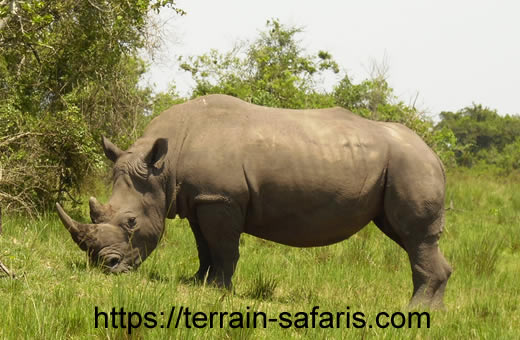
Southern white rhinos are the second largest land mammal after the elephant, and they are generally calm, grazing animals. Under the guidance of a ranger, visitors are able to observe them at a respectful distance, usually in small groups of mothers and calves or solitary adults. Rangers know the animals individually, often by name, and are able to explain their family relationships and histories, which adds depth to the encounter. Reports suggest that visitors typically see several rhinos in a single outing, and sightings are considered very likely, although, as with any wildlife experience, they cannot be absolutely guaranteed.
Photography is welcome, though visitors should follow the ranger’s instructions at all times, remain quiet, and avoid sudden movements. Rangers will position the group downwind of the animals and maintain a safe distance, and when the guidelines are followed, the experience is considered safe.
Other Activities at the Sanctuary
Although rhino tracking is the principal attraction, Ziwa offers a number of supplementary activities that make it a worthwhile half-day or full-day stop. Bird watching is rewarding, as the mix of savannah, woodland, and wetland supports a diverse range of species. The sanctuary is also known as one of the more accessible places to look for the shoebill, the large, prehistoric-looking wetland bird that is a highlight for many birders, and canoe or boat excursions through the swamp are available for this purpose. Nature walks, night tracking, and overnight stays are also offered, and some visitors choose to stay at the on-site accommodation to experience the sanctuary in the early morning, when wildlife is most active.
For birders, Ziwa pairs well with a wider northern Uganda itinerary, since it lies on the route to Budongo Forest and Murchison Falls National Park, both of which offer excellent birdwatching of their own.
Fees and Costs
Tracking fees are modest compared with many wildlife experiences in Africa. Most sources indicate that rhino tracking costs approximately USD 50 per person for foreign non-residents, with somewhat lower rates for foreign residents and for East African citizens. Some sources quote slightly higher figures, up to around USD 75, depending on what is included. Night tracking is reported at approximately USD 60 per person, and separate fees apply for activities such as shoebill canoe excursions and bird watching.
Because rates are revised periodically and vary by source, we would recommend confirming the current tariff with the sanctuary or a licensed tour operator before travelling. It is also worth remembering that the fees contribute directly to the cost of rangers, anti-poaching patrols, and veterinary care, so every visit supports the continued protection of the animals.
When to Visit
Ziwa can be visited at any time of year, though the drier seasons generally offer the most comfortable conditions. These typically run from December to February and from June to September. During these months, the grass is shorter and trails are firmer, which makes it easier to locate and observe the rhinos. The wetter months can make some tracks muddy and the vegetation denser, but the sanctuary remains open and the experience is still rewarding.
Early morning and late afternoon are generally the most pleasant times of day for tracking, since temperatures are cooler and the animals are often more active. Visitors should plan accordingly and allow sufficient time for both the drive from Kampala and the tracking itself.
Getting There and Planning Your Visit
Ziwa is approximately a two-and-a-half to three-hour drive from Kampala, depending on traffic, and it sits conveniently on the road towards Murchison Falls National Park. This makes it an ideal stopover on the journey north, breaking up what would otherwise be a long drive and adding a distinctive wildlife encounter to the itinerary. Many travellers visit in the morning, continue to Murchison Falls or Budongo Forest in the afternoon, and combine it with other northern highlights.
Visitors should wear closed, comfortable shoes and neutral-coloured clothing, and bring sun protection, drinking water, insect repellent, and binoculars. A camera with a modest zoom lens is usually sufficient, as the animals can often be approached quite closely. A light rain jacket is advisable during the wetter months.
Why Ziwa Matters
Beyond the pleasure of the experience itself, a visit to Ziwa contributes to something of lasting significance. Rhinos remain under serious pressure across Africa, and Ziwa demonstrates what sustained investment, community support, and careful management can achieve. The return of rhinos to Uganda is far from complete, but it is a remarkable beginning, and visitors have the opportunity to be a part of it.
Conclusion
Ziwa Rhino Sanctuary offers an accessible, affordable, and meaningful wildlife encounter, set close to the main route between Kampala and the northern parks. With the opportunity to walk within a short distance of rhinos, to learn about conservation first-hand, and to combine the visit with birding and other activities, it is a worthwhile addition to almost any Ugandan itinerary. For visitors who wish to see the country’s wildlife in its full diversity, and to support a genuine conservation success story, a morning with the rhinos of Ziwa is time well spent.